Perhaps belonging isn’t a destination we arrive at. Perhaps it’s a way of learning to stand, gently and honestly, in our own lives.
There are questions that stay with us because they refuse to be answered quickly.
What does it mean to live well?
What makes a life meaningful?
Where is home?
And perhaps one of the oldest questions of all:
Where do I belong?
It is a question we begin asking long before we have words for it.
Children ask it with their eyes before they ask it with language.
Teenagers ask it as they search for friends who understand them.
Adults ask it in quieter ways—in new workplaces, unfamiliar cities, changing relationships, places of worship, community gatherings, and sometimes even in their own families.
We spend much of our lives looking for signs that say,
“You are welcome here.”
Perhaps belonging isn’t something we finally discover. Perhaps it is something we help create – one welcome, one conversation, one act of courage at a time.
Belonging is often imagined as a place.
A family.
A neighbourhood.
A circle of friends.
A nation.
A faith community.
All of these matter.
Human beings were never meant to journey alone.
Yet something curious happens when we place all our hope for belonging outside ourselves.
We begin waiting for other people to decide whether we deserve it.
Approval slowly becomes permission.
Acceptance becomes identity.
And our sense of self rises and falls with every invitation, every compliment, every rejection.
It is an exhausting way to live.
Perhaps that is why some people can stand in a crowded room and still feel invisible.
While others, sitting quietly with one trusted friend, feel completely at home.
The difference is not always the room.
Sometimes it is the relationship we have with ourselves.
Belonging is not the same as fitting in.
Fitting in asks,
“What must I change so I can stay?”
Belonging asks,
“What happens if I arrive as I am?”
The first is built on performance.
The second on presence.
One is fragile.
The other can quietly endure.
This doesn’t mean belonging is easy.
It asks something courageous of us.
To be known.
Not the polished version.
Not the version carefully edited for approval.
The real one.
The one that carries doubts alongside dreams.
The one still learning.
Still healing.
Still becoming.
Perhaps that is why genuine belonging feels so rare.
It requires honesty from us and generosity from others.
Neither can be rushed.
There is a beautiful idea within Ubuntu that reminds us our humanity is discovered in relationship.
Not because other people complete us.
But because they reveal parts of ourselves we could never discover alone.
The kindness we offer.
The patience we struggle to practise.
The forgiveness we find difficult.
The love we are capable of giving.
Community becomes a mirror.
Not one that judges us.
One that helps us see more clearly.
Maybe belonging has never been about finding the perfect place.
Maybe it begins much earlier.
The moment we stop hiding.
The moment we stop performing.
The moment we discover that we do not need to earn the right to exist with dignity.
From there, communities become something beautiful.
Not places where we search for our worth.
Places where we share it.
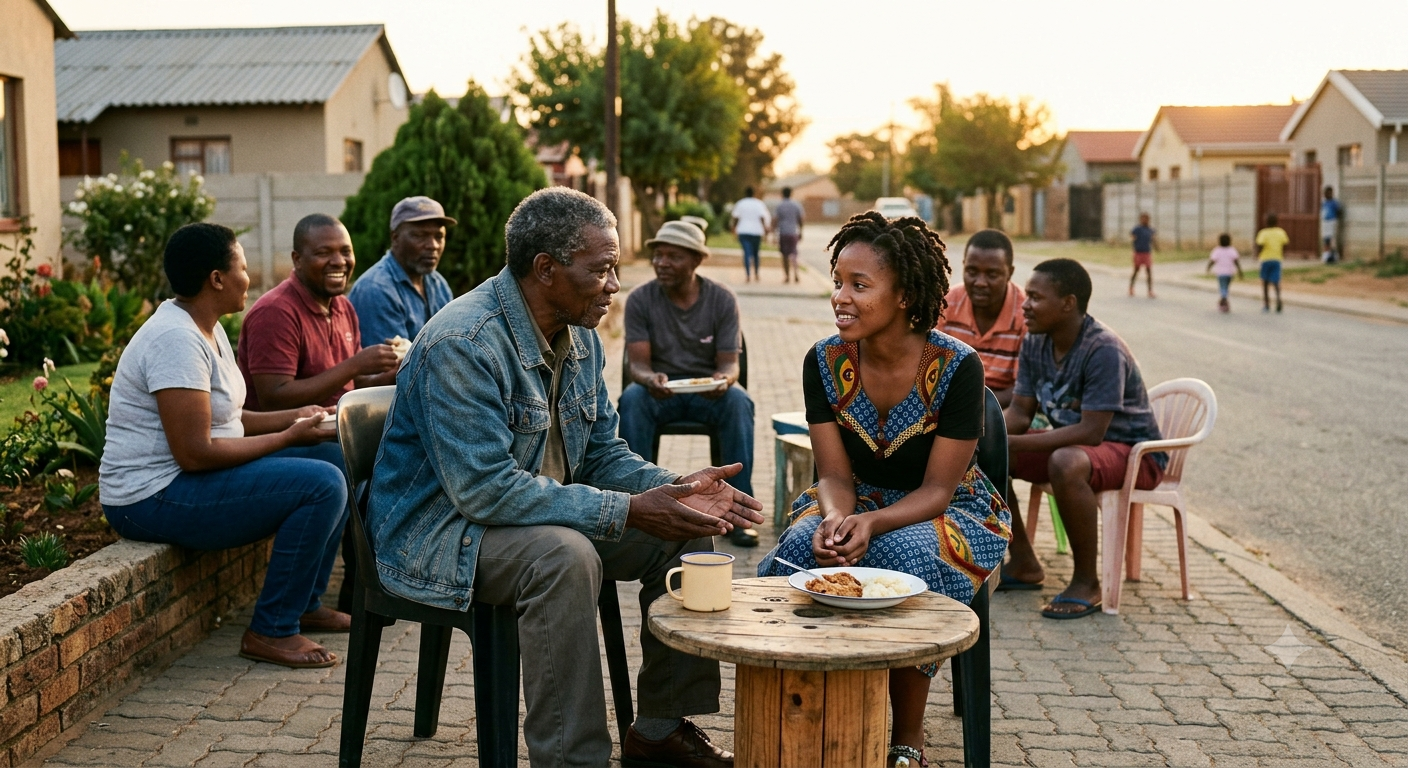
‘When I moved to Cape Town for university, I spent months trying to become the person I thought everyone wanted me to be. It wasn’t until I stopped pretending that I found friends who loved the real me.’
Aphiwe
Cape Town

Who has helped you feel that you truly belonged – and what did they do that made such a difference?