The return of Thubega and Marathwane marked not only the restoration of hope but the birth of an age unlike any before. The people who had once struggled to tame the banks of the Oodi—drinking when rains fell, starving when the earth hardened—now found themselves standing at the threshold of abundance.
As the months passed, the king and queen began to reveal the sacred lessons entrusted to them by Ambupa and Waroni. They spoke not merely of tools and techniques, but of a new way of being, where the land itself sang in harmony with those who lived upon it.
The first of these gifts was water, the very blood of the earth. The Banokeng had always drawn water from the river by hand, carrying clay pots along worn paths, praying that the floods would not take their homes nor the droughts take their lives. But Thubega showed them a new way.
At his command, the men of the tribe dug deep channels branching from the river like veins from a heart. Using woven baskets of reeds, they carried wet clay, shaping the channels so the water could flow evenly into the fields. Stones lined the larger canals, while polished wood diverted streams into smaller furrows.
“This is the lifeblood of the people,” Thubega told them. “It shall flow not only where chance dictates, but where wisdom directs.”
They built small gates of wood and stone—primitive sluices—that could be raised or lowered with ease. These became their guardians against flood and famine, controlling the water’s strength. The children watched in awe as once-thirsty soil grew damp and dark, ready to yield grain even in the dry season.
Where before the Banokeng harvested with uncertainty, they now saw fields of sorghum, millet, and beans rise in abundance. The kingdom began to trade surpluses of grain, exchanging it with neighbouring tribes for cattle, iron, and salt.
But irrigation alone was not the heart of this prosperity. Marathwane, radiant in her role as Mother of the Waters, taught that the land responded not only to hands but to voices and to bodies.
“The water gods have revealed to us,” she declared before the elders, “that the earth does not grow from labour alone. The land listens. The seed listens. All life bends to the Voice of Creation, and to the dance of its people.”
And so they learned. In the quiet of dawn, before the world woke, they practised the Whispers of the Source, a silent communion with the faint hum that lay beneath all sound—the vibration of life as if the earth itself was breathing. Hunters and mothers alike spoke of hearing it, a pulse that connected every living thing. At planting time, they knelt, holding a seed in their hands. This was the Inner Word, a silent, powerful visualisation of the seed’s journey from a dry kernel to a flourishing stalk, its future life imagined in the mind. Then, with a soft melody, they released the Shaping Breath, a gentle exhalation that carried intention from their bodies into the soil, coaxing unseen forces to nourish the waiting seeds.
Finally, in times of great need, their bodies became the fourth voice—the Dancing Prayer. They moved with a primal grace, their steps mimicking the flow of the river, the sway of the reeds, the thunder of a coming storm. The Spoken Command was woven into their movements, a resounding chant that could move the waters and command the stalks to stand tall. Their dance was a physical manifestation of their collective will, a living hymn to the land itself.
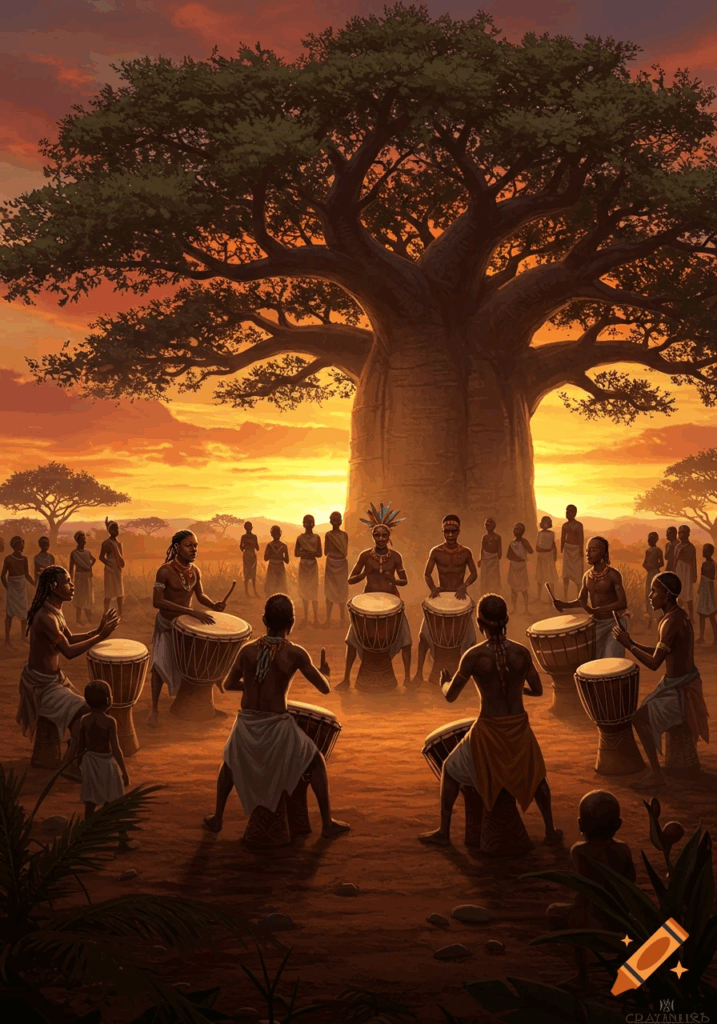
Fields sang and swayed with these voices. Women sang as they pounded grain, men sang and danced as they raised canals, children hummed and mimicked the graceful movements. The Banokeng became a people of song and dance, their lives carried by a rhythm older than memory.
“When others chose land, we chose the river. In its flow, we saw not just water, but the path of destiny.”
With food secured, health was the next blessing. From Waroni’s teachings, Marathwane shared the lore of the riverside herbs. They learned to boil willow bark for fevers, to pound the leaves of wild basil for coughs, to crush aloe for wounds and burns.
But the greatest gift was purification. No longer would the people drink only from the river, risking sickness from unseen spirits in the water. Marathwane showed them how to build stone basins lined with clay, filtering water through sand and charcoal. What emerged was clear, cool, and clean—a drink fit for kings but shared freely with all.
Dance was woven into their healing practices, too. A wounded warrior would not simply rest; he would be guided through a slow, rhythmic healing dance, his movements designed to rebalance the body’s life-force and coax a swift return to health. The steps were gentle but deliberate, a graceful mending of spirit and flesh.
The Banokeng grew strong. Children survived where once they had withered, and warriors healed from wounds with new speed.
The knowledge of Ambupa was not limited to the soil. The Banokeng learned the secrets of metals and gems hidden in their lands. They smelted copper from the red stones of the hills, shaping it into tools and ornaments. They discovered veins of gold dust in the riverbanks, learning to pan it with woven trays until glittering specks gleamed in the sun.
Goldsmiths rose among them, guided by chants that steadied the hand and sharpened the eye. Bead-makers strung bright shells and polished stones into patterns that spoke of rivers, stars, and ancestors. Cattle multiplied in the green pastures, their horns painted with sacred ash during ceremonies.
Even the crocodile, once feared as devourer of men, was given its place in the order. Hunters learned how to read its moods, how to call it away from the fishing nets with certain sounds, and how to use its presence as a guardian against intruders.
Prosperity attracted envy. And so, the Banokeng learned not only to feed their people, but to defend them. Under Thubega’s direction, they constructed walls from packed earth and riverstone, bound with clay and hardened by fire. These encircled their settlements like the ribs of a great beast.
Warriors trained in new formations. They learned to lock shields of cowhide into walls, to move as one body, to wield spears in disciplined ranks rather than chaotic swarms. The chants of creation accompanied them here too, for battle was not merely force but rhythm. Their movements became the war dance, a fluid, synchronised display of power that flowed with the discipline of the river itself.
Their might was tested in skirmishes with raiders, but never broken. Stories spread of the River People—farmers, healers, singers, dancers, yet also fierce defenders of their land.
“A wave of stillness spread over the crowd. Quarrels ceased, murmurs stilled, and even the children fell quiet. Every heart seemed to slow in unison with the calm pulse radiating from the form.”
Together, these gifts transformed the Banokeng. Where once they were wanderers, now they were rooted. Where once they prayed for survival, now they planned for generations.
Thubega and Marathwane often walked the fields at dusk, listening to the hum of the people’s chants and the soft thud of their dancing feet, their rhythms mixing with the whisper of the river. Their eyes met, and they knew: they were no longer merely leaders. They had become guardians of a covenant between man, land, and water.
The Banokeng kingdom flourished, its influence stretching along the Oodi’s winding banks. Neighbouring clans came to trade and learn, astonished at the abundance they found. The River People offered grain, medicine, wisdom, and dance, and in return received respect, alliances, and peace.
It was the dawn of an age that would echo across centuries—an age born of water, word, and the unbreakable harmony between gods and mortals.
But even as joy surged, the king’s eyes often wandered east, toward the rising sun. Marathwane, too, sometimes fell silent, her gaze distant. For they remembered the warnings of Ambupa and Waroni—that the age of peace would not last unbroken. Across the horizon, storms of iron and fire would one day roll, bringing strangers who sought to break and scatter.
For now, however, they guarded their gifts and built their kingdom strong, the people united, their faith unshakable.
The river had taken their leaders.
The river had returned them as gods.
And under their reign, the Banokeng would rise into legend.
TUNE IN NEXT WEEK FOR ANOTHER EPISODE….