“Sometimes the hardest words aren’t ‘I can do it.’ They’re ‘I can’t do this alone.'”
An earring is an earring.
At least, that is how we tend to see it.
Something worn. Something decorative. Something chosen because we like the way it looks.
Its purpose seems settled.
Most of the things around us are like this. A chair is a chair. A road is a road. A phone is a phone. We inherit a world full of objects whose purposes seem obvious because someone, somewhere, has already decided what they are for.
Until someone looks at one of them differently.
In Limpopo, a sixteen-year-old schoolgirl looked at an earring and saw something else.
Her name was Bohlale Mphahlele.
Bohlale had been encouraged by her father to watch the news from a young age.
The stories accumulated.
Women experiencing violence. Children being harmed. Human trafficking. The ordinary fear that can enter people’s lives without warning.
For Bohlale, these were not simply stories appearing on a screen. They became something she kept thinking about.
And somewhere in those thoughts, an idea began to form.
What if something small and familiar could help someone in danger?
The idea did not arrive fully formed.
According to reports from the time, Bohlale had been thinking about it for years before she formally developed it as a school project. Eventually, the thought became something she could write down, experiment with and try to build.
An earring could do something else.
She called the idea the Alerting Earpiece.
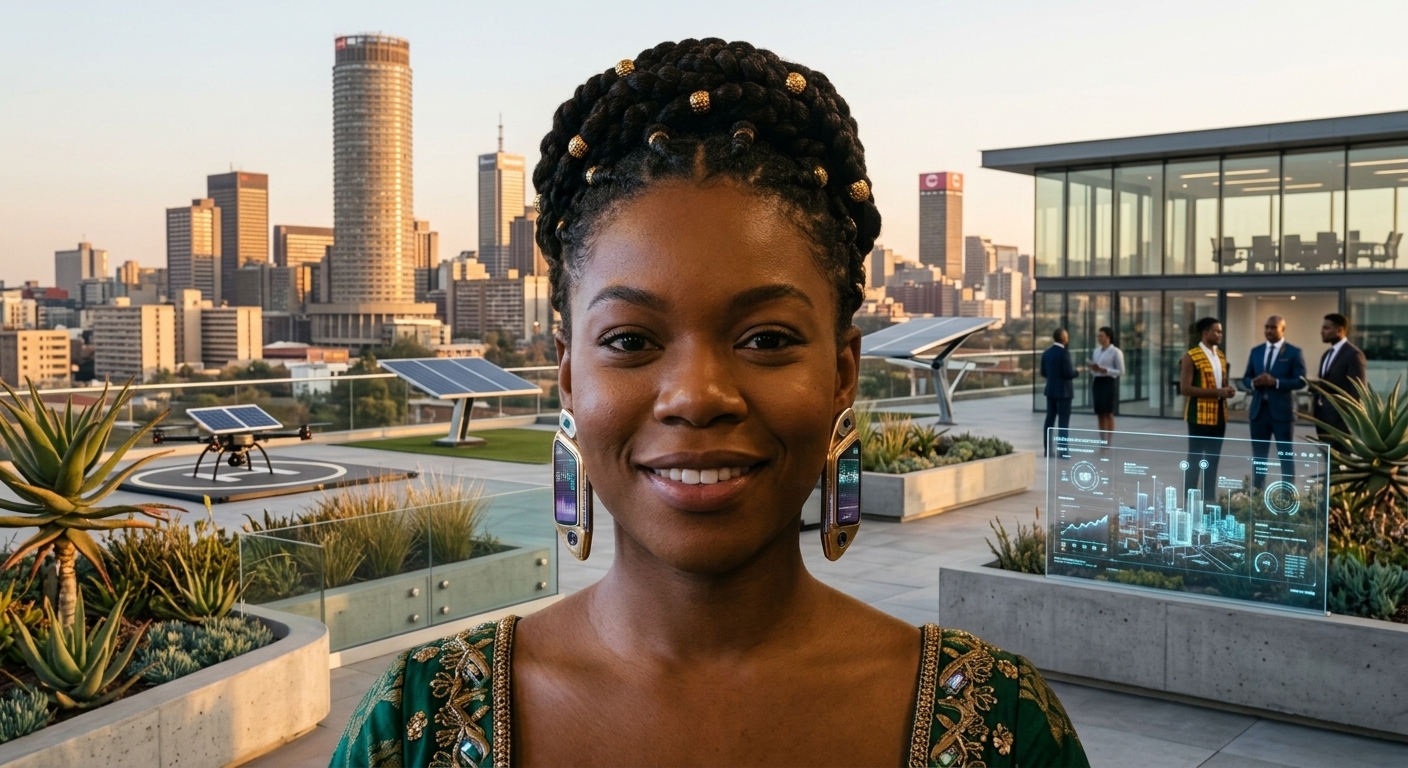
The prototype was designed to resemble an ordinary earring while incorporating technology intended to assist someone facing danger, including an alert function and the ability to capture information that could help identify a perpetrator.
It was an unusual answer to a frightening problem.
But perhaps the more interesting part of the story happened before there was a prototype.
Someone had to look at the problem.
And then someone had to look at the world around the problem and wonder whether one of the things already sitting inside that world could be used differently.
There is something quietly radical about seeing a familiar thing differently.
We become accustomed to the purposes of things.
We learn what an object is called before we ever learn to question what it can become.
Perhaps that is partly because familiarity is efficient. We don’t need to reconsider everything we encounter every morning. We know what a door does. We know what a spoon does. We know what an earring does.
But familiarity has another effect.
It can make possibilities invisible.
Bohlale’s idea began by disturbing that certainty.
The earring was no longer only an earring.
The problem was no longer only a problem.
The relationship between them had changed.
And from that changed relationship, a possibility appeared.
Bohlale’s story might be easy to tell as a story about individual brilliance.
A gifted teenager sees a problem.
She invents something remarkable.
She wins an award.
The end.
But that version leaves out something important.
She was not imagining in isolation.
She was a student at SJ van der Merwe Technical High School in Limpopo. Her school had a science club. Teachers and mentors helped learners develop their projects. The Eskom Expo for Young Scientists provided somewhere for young people to take their ideas beyond the classroom and put them in front of other people.
The idea had found somewhere to go.
That matters.
Because imagination is private.
Possibility is not.
An idea can exist quietly inside one person’s mind for years. It can be written in a notebook, discussed with a parent, sketched on paper or carried around as a thought that never quite finds its moment.
But something changes when another person takes it seriously.
A teacher listens.
A mentor helps.
A school provides equipment.
A competition creates a platform.
Someone says: Let’s see what this could become.
The idea has crossed a small but important boundary.
It is no longer only imaginable to the person who imagined it.
Someone else can see it too.
In 2020, Bohlale presented the Alerting Earpiece at the Eskom Expo for Young Scientists.
She was sixteen.
The invention received a bronze medal.
The medal did not solve gender-based violence.
It did not turn a prototype into a finished product.
It did not prove that every part of the idea would work in the world exactly as imagined.
But recognition does something different.
It tells an idea that it has been seen.
And sometimes that is the beginning of a different kind of possibility.
Until that point, Bohlale could imagine the earring doing something differently.
Afterward, other people could imagine it too.
That distinction may be more important than it first appears.
We often speak as though the movement from imagination to reality is a straight line.
Someone imagines something.
They build it.
The world changes.
But there are usually more steps between imagination and reality than we notice.
There is recognition.
There is encouragement.
There is criticism.
There is access to knowledge.
There are resources.
There are institutions.
There is persistence.
There is the difficult space between this could exist and this now exists.
Bohlale’s story is still somewhere inside that space.
The Alerting Earpiece remains a project being developed.
And perhaps that makes the story more interesting, not less.
Because an unfinished possibility is still a possibility.
There is another question hiding here.
We are often drawn to exceptional people because they give us satisfying stories.
This person was different.
This person saw what others couldn’t.
This person had the courage, talent or imagination to do something remarkable.
There is nothing wrong with recognising achievement.
But sometimes calling someone exceptional allows the rest of us to stop asking questions.
We can admire the person and move on.
Bohlale was exceptional.
But what made her possibility visible?
She had a father who encouraged her to pay attention to the world.
She had a school environment where scientific curiosity could be developed.
She had teachers and mentors.
She had access to a platform where her idea could be seen.
She encountered institutions that could say, in effect:
This is worth looking at.
How many ideas never receive that moment?
How many young people notice things that adults have stopped noticing?
How many strange questions are abandoned because nobody takes them seriously?
How many possibilities remain private simply because there was nowhere for them to go?
We cannot know.
But the question is worth asking.
Every society has an invisible map of possibility.
It is rarely written down.
But we learn it.
We learn what people like us are expected to become.
We learn which questions are considered sensible.
Which ambitions are realistic.
Which ideas belong in laboratories.
Which belong only in dreams.
Which careers seem open to us.
Which problems are considered too large to touch.
This map is shaped by families, schools, communities, institutions and the stories we hear about people who came before us.
It can expand.
It can contract.
And sometimes a person comes along who, without necessarily intending to, redraws a small part of it.
Bohlale did not solve the enormous problem she was responding to.
But she demonstrated that a problem could be approached from an unexpected direction.
A familiar object could be reconsidered.
A schoolgirl could enter a scientific space with an idea born from something she had been seeing on the news.
And other people could look at that idea and say: There may be something here.
That is how a possibility begins to move.
There is a paradox here.
We are shaped by the worlds we grow up in.
They teach us what exists.
They give us language for describing it.
They show us examples of what people have done.
They establish the boundaries of what seems reasonable.
And yet, every so often, someone imagines something that was not visible within those boundaries.
Where did that possibility come from?
Perhaps imagination does not simply stand outside society and challenge it.
Perhaps society gives imagination some of its material.
Bohlale saw a problem because she was paying attention to the world around her.
Her education gave her tools with which to think about that problem.
Her environment gave her a place to develop the thought.
And then, once the idea became visible to others, it could begin to influence what they imagined too.
The movement can go both ways.
Society shapes imagination.
And sometimes:
imagination reshapes the horizon of society.
That may be one of the quieter ways change begins.
Not when something new suddenly appears, but when something that did not seem possible becomes possible to imagine.
Perhaps this is why the story of an earring matters.
Not because an earring is revolutionary.
It isn’t.
Not because every problem can be solved by technology.
It can’t.
And not because every unusual idea deserves to become reality.
It doesn’t.
The interesting thing is the moment before all of that.
The moment when something familiar stops being quite so familiar.
When someone asks a question that changes the relationship between things.
When an idea exists before the world has decided what to call it.
And then, perhaps most importantly, when someone else sees enough in that idea to say:
Keep going.
Maybe possibility does not belong entirely to the person who first imagines it.
Perhaps it becomes larger when other people can see it too.
Perhaps the future is shaped not only by the people who imagine differently, but by the people and places willing to recognise what they see.
Which leaves us with a question.
Not simply about invention.
Not simply about young people.
Not even simply about Bohlale.
But about the world we are making together:
What happens when one person’s imagination becomes imaginable to others?
And perhaps, beneath that:
How much of what we think is impossible is simply something we have not yet learned to see?
Before something becomes real, it often exists only as a possibility.
What are you carrying today that has not yet found its shape?
Join the conversation.
Some things begin as a thought, a question, a quiet sense that something could be different.
What are you beginning to imagine?