A conversation about identity, belonging, and the quiet search for a place where we can simply be.
Belonging sounds simple until you put people in a room and ask them what they mean by it.
For one person, it may be about home. For another, a fair chance. For someone who has moved across a border, it may mean no longer being treated as though they are only passing through. For someone who has spent their whole life in one place, it may be tied to memory — the streets, people and rhythms that have shaped a life.
We brought five people together to sit with a question that grows more complicated the longer you stay with it:
Who gets to belong?
There was no expectation that they would agree.
“I think you know when you belong somewhere,” says Lerato.
She has spent the last few years moving between temporary jobs and looking for something more permanent.
“You don’t have to think about it. You just arrive.”
She remembers an interview for a job she wanted badly.
Everyone was polite. Nobody said anything unkind. But the people in the office seemed to know one another already. They joked easily. They understood one another’s humour. They seemed to know how much to say, and when.
“I remember thinking about everything before I opened my mouth,” she says. “How I sounded. Whether I was talking too much.”
Was it simply nerves?
“Maybe. But you can tell when you’re the person who has to work out how the room works.”
Amara recognises the feeling, although hers has followed her beyond a single room.
She moved to South Africa several years ago.
“People ask where you’re from,” she says. “That’s normal. I ask people where they’re from.”
She smiles.
“But sometimes there are other questions after that. How long have you been here? Do you have family here? Are you staying?”
“And after a while,” she says, “you start wondering what the person is really asking.”
Thabo, who owns a small business in a neighbourhood that has changed considerably over the years, sees another side of the question.
“I understand that,” he says. “But I also think people who arrive somewhere don’t always realise that a place already has a history.”
People have lived there. Raised families. Built businesses. Developed ways of doing things.
“You can’t arrive and act as though the place started when you got there.”
Amara nods.
“I agree with that.”
Then she adds:
“But why does my arrival have to mean your history is gone?”
Thabo takes a moment.
“I’m not saying it does.”
“I know,” she says.
Zanele has worked with communities for years.
“I think we’re very comfortable saying everyone is welcome,” she says. “Until people actually arrive.”
Thabo laughs.
“That’s a bit harsh.”
“Is it?”
“Maybe.”
She continues.
“We say, ‘You’re welcome here.’ Then someone does something differently and suddenly they’re told they don’t understand the community.”
“Sometimes they don’t,” Thabo says.
“Of course they don’t. They’ve just arrived.”
“So should they adapt?”
“Yes.”
The answer comes quickly.
Thabo looks at her.
“Then we’re agreeing.”
“Not yet.”
She laughs.
“The question is what we mean by adapt.”
“Okay. What do you mean?”
“Take language. If you move somewhere and you don’t understand the language people use around you, of course you should try to learn. That’s part of living with people.”
“And?”
“And learning doesn’t mean everything you brought with you has to disappear.”
Thabo isn’t entirely convinced.
“I don’t think anyone is asking that.”
“Maybe not directly.”
Musa, who has mostly been listening, joins in.
“This is where these conversations become difficult.”
Everyone turns toward him.
“One person thinks they’re asking for something reasonable,” he says. “The other person experiences it as something completely different.”
Nobody seems to disagree.
That doesn’t mean they agree.
Lerato brings the conversation back to work.
“I think this happens in workplaces all the time,” she says.
“You learn what kind of person they want.”
Thabo asks what she means.
“Not because someone tells you. You just pick it up.”
How people speak.
What kind of humour is acceptable.
What is considered confident.
What is considered too much.
“You start adjusting.”
“Is that necessarily a bad thing?” Thabo asks. “Any workplace needs people who can work together.”
“No. Of course not.”
She thinks for a moment.
“But there’s a difference between learning how to work with people and feeling like the person they want is basically someone who already looks like everyone else in the room.”
Thabo considers that.
“So how do you know when you’re adapting and when you’re becoming somebody else?”
Lerato laughs quietly.
“That’s the problem.”
Amara nods.
“I’ve changed the way I speak.”
Not completely, she says. Just certain words.
“You learn which ones people don’t understand.”
Does she still do it?
“Yes.”
“Why?”
She shrugs.
“Sometimes I don’t have the energy to explain myself.”
Zanele nods.
“That kind of thing is easy to miss if you’re not the one doing it.”
Thabo looks at her.
“But isn’t some of that just part of living with other people?”
“Sometimes.”
“So what’s the alternative?”
Zanele smiles.
“I don’t know.”
Then she adds:
“That’s why we’re here.”
Thabo has been quiet for a while.
“I’ll say something that maybe people won’t like.”
“Go on,” Musa says.
“I think belonging comes with responsibility.”
No one immediately disagrees.
“If you come into a community, you can’t only ask what the community owes you. Surely you also have to ask what you’re bringing.”
Amara nods.
“I agree with that.”
Thabo smiles.
“There must be a but.”
“There is always a but.”
She laughs.
“But if belonging comes with responsibility, then that responsibility has to go both ways.”
“If I’m new, I should make an effort. I should learn. I should respect the people around me.”
Thabo nods.
“But if I’ve been making that effort for ten years,” she continues, “I don’t want to still be reminded that I arrived later.”
Thabo sits with that.
“I can understand that.”
Zanele picks up the thread.
“That’s where it gets interesting.”
A person arrives and starts asking questions.
Why do you do things this way?
Could this be done differently?
Sometimes those questions are heard as curiosity. Other times, as criticism.
“Or maybe they are criticism,” Thabo says.
“Maybe.”
“And then?”
“I don’t know.”
Thabo laughs.
“You keep saying that.”
“Because I don’t think every question has a clean answer.”
Musa smiles.
“Now we’re getting somewhere.”
Musa has spent years attending neighbourhood meetings, working on community projects and watching disagreements unfold between people who often claim to want the same thing.
“People think they’re arguing about the thing in front of them,” he says.
“They’re not?”
“Sometimes. But often there’s something underneath.”
“What?”
He thinks for a moment.
“Who gets to decide.”
That, at least, everyone recognises.
Someone says:
This isn’t how we do things here.
Another person asks:
Who is ‘we’?
The disagreement is suddenly about something much larger.
Thabo smiles.
“Sometimes somebody has to decide.”
“Of course,” Musa says. “But who?”
“Someone who’s been there long enough, maybe.”
Zanele immediately asks how long is long enough.
Thabo laughs.
“You’re not going to let that go, are you?”
“No.”
The room laughs, but Thabo becomes more serious.
“Look, I’ll be honest. Sometimes I worry about things changing too quickly.”
He talks about the neighbourhood where he grew up.
His parents worked there.
He knows the old shop owners. He remembers which families lived where.
“Sometimes I drive through and I don’t recognise it.”
Amara looks across the table.
“I understand that.”
She pauses.
“I really do.”
“But sometimes when people say they don’t recognise their community anymore, I wonder whether they mean they don’t recognise the people in it.”
Nobody laughs.
Thabo looks down.
“That’s possible.”
Musa speaks quietly.
“And sometimes both things can be true.”
No one rushes to fill the silence.
Lerato thinks belonging has something to do with being given a fair chance.
Amara wants to reach a point where she doesn’t have to explain herself before she can simply participate.
For Thabo, belonging includes knowing that what came before him still matters.
Zanele is concerned with who gets a voice in shaping what comes next.
Musa, after listening to everyone, puts it more simply.
“Maybe it’s knowing your neighbours,” he says.
Actually knowing them.
Not simply knowing where they come from.
Or what they represent to you.
Two people can stand in the same place and both say:
I belong here.
Neither may be wrong.
But when different claims to belonging meet, the question becomes harder.
Who gets to stay?
Who gets to change?
Who gets to shape what comes next?
And, underneath all of it:
Who gets to belong?
END
Two people can stand in the same place and both feel that it is home.
One may carry its history.
Another may have built a life there.
Both may have a legitimate claim to belonging.
Perhaps belonging is not as simple as being welcomed.
Perhaps it is also about being able to participate, to contribute, to influence what comes next - without having to erase what came before.
Take a moment with that.
When does a place become yours?
And what happens when someone else's answer is different from your own?
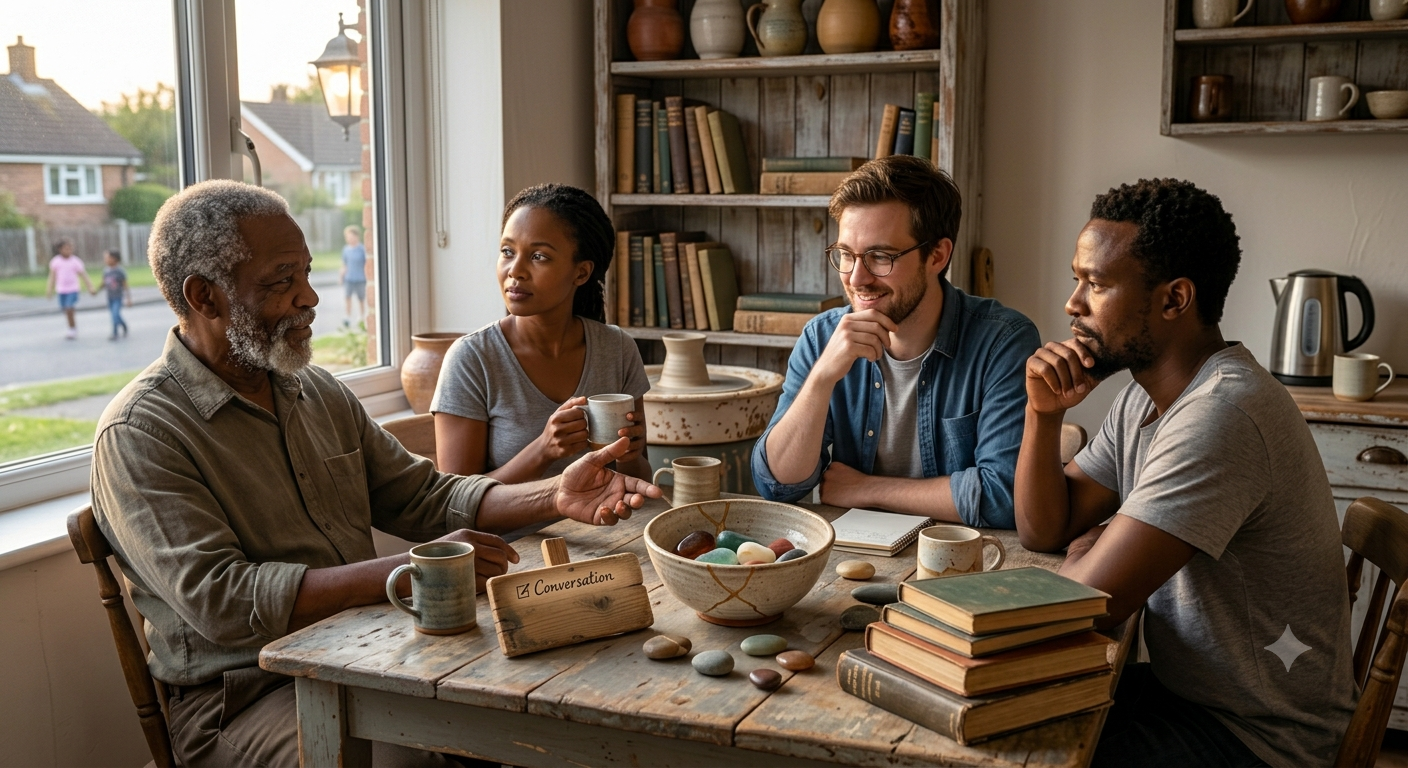
Pull Up a Chair
Belonging can feel very different depending on where you are standing.
For some, the question is whether there is still a place for them.
For others, it is whether the place they know and love is changing beyond recognition.
And sometimes, both are true.
So pull up a chair.
Think about a place you call home - a neighbourhood, a country, a community, a family, even a room where you have always felt you belonged.
Who gets to shape what that place becomes?
And when new people arrive, what do we owe one another?
There may not be one answer.
That is why we keep the conversation open.

“After my divorce, I kept asking when life would feel normal again. Looking back, I realise I wasn’t lost – I was simply learning to travel a different road.”
Zanele
Gqeberha